Tangxi Sword
Introduction
The Tangxi Sword is a renowned handmade weapon originating from Xiping County in Henan province, Central China. This traditional sword-making craft is celebrated for its intricate techniques and significant historical heritage. In 2014, it was officially recognized as a national intangible cultural heritage, highlighting its cultural and artistic value.
The Tangxi Sword-making tradition dates back to the Warring States period. Tangxi was a significant iron-smelting and sword-casting center during this era. The Tangxi iron-smelting site is one of the earliest and most well-preserved iron-smelting sites discovered in China, with a history spanning over 2,700 years. The craft has been passed down through the Gao family in Beigao village, Wuyang county, Henan. In the 1940s, Gao Xikun, a native of Wuyang county and a graduate of Beiyang University (now Tianjin University), established the first iron factory in Xiping County, expanding the craft's reach. His son continued the tradition by founding the Tangxi Sword Factory in Xiping county, dedicated to the research, production, and development of Tangxi Sword-making techniques.
The core area of the Tangxi Sword-making craft is in Xiping county, with its influence extending to parts of Wugang city, Suiping county, Biyang county, Wuyang county, and Yancheng county.
Craftsmanship
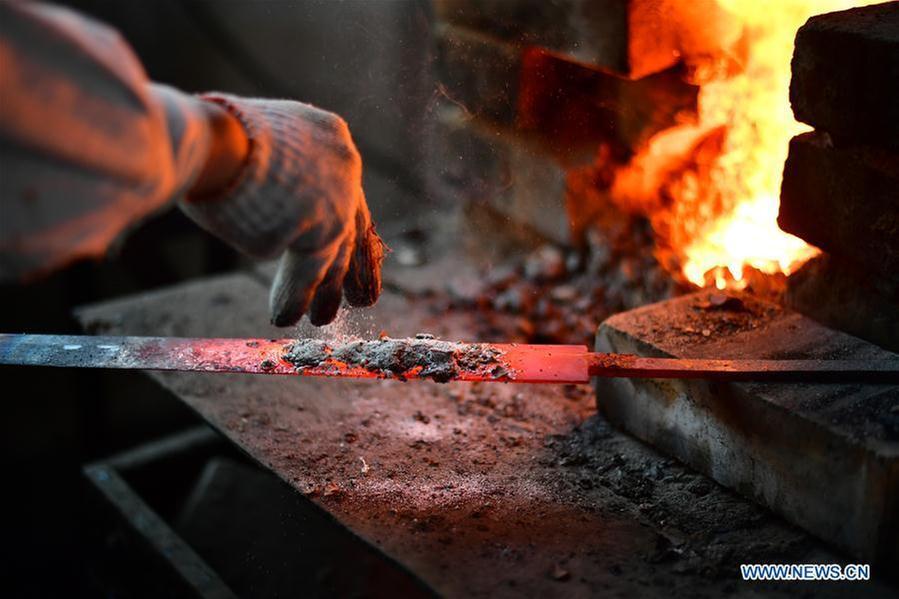
The process of making a Tangxi Sword is highly complex and involves over 300 meticulous steps. These include smelting, forging (both hot and cold), heat treatment (annealing, normalizing, tempering, and annealing again), polishing (coarse and fine), grinding (coarse, fine, and precision), engraving, and making the scabbard. The scabbard-making process involves wood baking, material selection, crafting, adhesion, repeated polishing, carving, painting (base coat, sanding, protective coat), and assembly.
This craft preserves ancient techniques of manual forging and metal modification. A special formula is added to Longquan water used for quenching, modifying the metal properties of the sword. The resulting swords are strong, resilient, hard, and flexible, capable of cutting through iron and bending 90 to 120 degrees without deforming. The blade reflects light like frost and exudes an aura of elegance.
Cultural Significance
The Tangxi Sword is not only a weapon but also a cultural artifact, symbolizing the rich history and craftsmanship of the region. The dedication of artisans in preserving this tradition underscores its importance as a cultural and artistic treasure.








